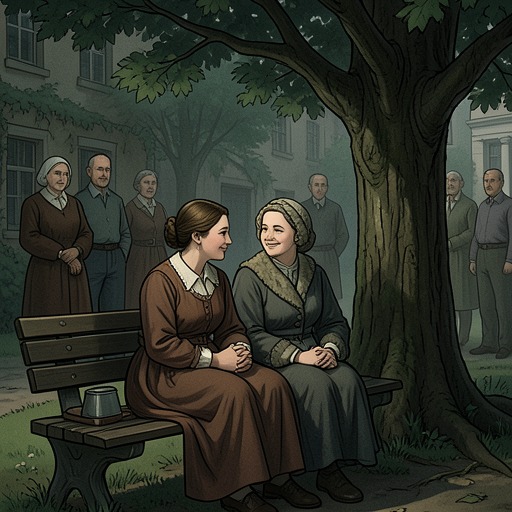
Autje and Neitje’s close friendship
Women TalkingAutje Loewen and Neitje Friesen’s close friendship takes shape through practical trust and quiet companionship. The novel offers no account of how the friendship began or how long it has lasted; instead, it shows the two young women repeatedly acting together. They share private understanding within the women’s meeting, make plans beyond the meeting’s formal discussion, and help secure the horses and other conditions needed for departure. Their bond is most legible in what they do for and alongside each other.
Companionship in the meetings
At the gathering, Autje Loewen and Neitje Friesen are sometimes apart from the other women, sitting on a window ledge or on saddles taken from Earnest Thiessen’s tack room. Their closeness is not presented as a separate argument or declaration. It is part of the meeting’s lived arrangement: the two young women share space while the adults consider the choices facing the colony.
A more telling moment comes when Neitje Friesen goes to sit beside Autje Loewen. Neitje has nothing to tell her and nothing to give her, but synchronizes her breathing with Autje’s. They look forward and remain silent. The scene makes companionship an act of presence rather than explanation. Neither woman is required to solve the other’s difficulty in that moment; their shared rhythm is enough to register their closeness.
That nonverbal understanding also appears in their coordination around the yearlings. When Klaas Loewen asks where the animals have gone, Autje Loewen and Neitje Friesen stand behind him and use hand gestures to signal the other women that they have turned the yearlings out to graze. Their communication is brief and discreet, allowing them to share information without announcing their action to him. The incident gives their friendship a practical dimension: they can act in concert and communicate quickly when the women’s plans require discretion.
Protecting Ruth and Cheryl
Their most extended joint undertaking concerns Ruth and Cheryl, Greta Loewen’s horses. After Klaas Loewen leaves to have a tooth treated by Agata Friesen, Autje Loewen slips out of the house and runs to get Neitje Friesen. The two then go to Greta Loewen’s barn, saddle Ruth and Cheryl in darkness, and ride them to Chortiza Colony. Their choice to move the horses together protects a resource that Greta’s team will need when the women leave.
At Chortiza Colony, they meet the Koop brothers behind the church and persuade them to shelter Ruth and Cheryl overnight. The arrangement is temporary but carefully timed: the brothers are to return the horses to Greta’s barn early the next morning, after Klaas has gone to the city. In this way, the horses can be back in Molotschna and ready for the women’s journey without being available to Klaas when he leaves.
Neitje Friesen recounts the plan to the women. When Salome Friesen asks how the girls persuaded the brothers to hide the horses, Neitje answers that it was easy because the brothers like them, and she exchanges a glance with Autje Loewen. That small shared look leaves their understanding partly private. Neitje also explains that the brothers brought the girls back to Molotschna on horseback, with the two riding behind them. The account makes clear that the plan depended on both women’s cooperation, their access to the brothers, and their ability to move the horses without drawing Klaas’s attention.
A partnership under pressure
The friendship is not limited to the horse plan. As the women prepare to leave before the men return, Autje Loewen and Neitje Friesen continue to act in tandem. Near the end, they appear together in the loft and warn August Epp to hide. When he emerges, he sees them standing beside Salome Friesen. Salome explains that, under her instructions, the two young women had drawn the Koop brothers to the loft so that she could prevent them from informing the men about the women’s departure. Their part in this plan is coordinated with Salome’s, but they enter and carry it out together.
The episode places their closeness within the larger danger surrounding the exodus. The women expect the men to return, and the Koop brothers might alert them or prevent the departure. Autje Loewen and Neitje Friesen’s shared role helps block that risk, while their earlier handling of Ruth and Cheryl has already helped prepare the journey. Their friendship therefore connects intimate loyalty to collective action: each task matters to the group, but the evidence repeatedly shows the two young women undertaking it as a pair.
Departure and significance
After Salome Friesen tells Autje Loewen and Neitje Friesen to go to the buggies waiting behind the schoolhouse, they climb down from the loft and leave Molotschna. They wave goodbye to August Epp over their shoulders and run away laughing. The farewell is diffident, but their movement is exuberant. The contrast gives their final appearance a lightness that does not erase the risk of leaving; it shows the two friends moving into the uncertain journey together.
The narrative does not define their bond by a confession, a dispute, or a single decisive exchange. Instead, it builds the relationship through repeated forms of mutual coordination: shared silence, gestures across a tense situation, a glance that confirms an understanding, and joint work to move the horses and secure the departure. Their friendship is both personal and consequential. It offers each young woman a companion, while also supplying the trust and cooperation on which the women’s collective plan depends.